
What Is an Axle Shaft?
An axle shaft—also called a half shaft or CV axle—transfers power from the transmission and differential to your wheels for smooth movement.
Three Axle Shaft Types
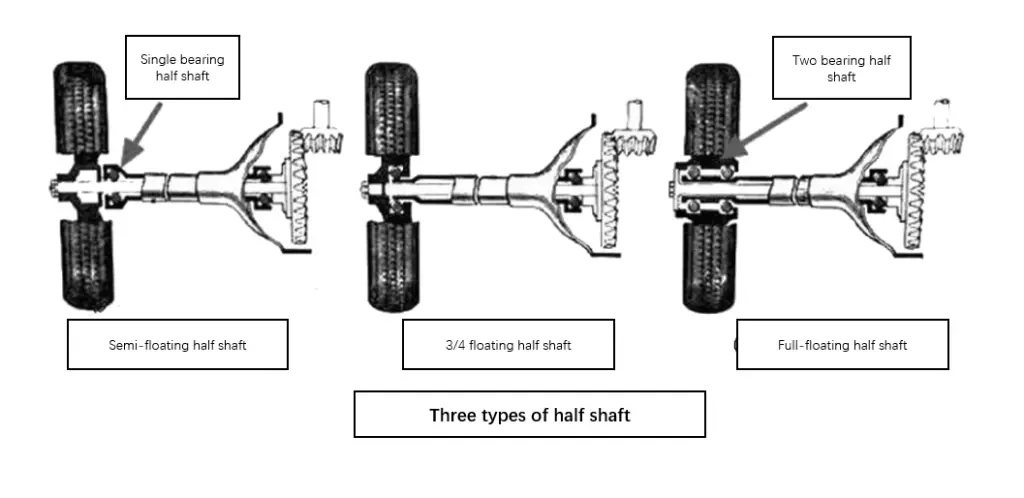
Semi-Floating Axle Shafts
Fully Floating Axle Shafts
Three-Quarter Floating Axle Shafts
From product design and manufacturing to installation and after-sales support, we ensure every step meets the highest standards of quality and reliability.
Our portfolio, from axle shafts to advanced differentials and transfer systems, is engineered to deliver reliable performance and give every driver the confidence to take on any road.
Features and Benefits
Drive Shaft vs Axle Shaft
| Item | Drive Shaft | Axle Shaft |
|---|---|---|
| Function | Transfers power from the transmission to the rear differential gearbox. | Transfers power from the differential to the wheels. |
| Basic form | Long, hollow metal tube with universal joints at both ends. | Solid rod with teeth (splines) cut into both ends. |
| Position | Runs along the center of the vehicle, visible under the chassis. | Concealed inside the perpendicular axle housing to each wheel. |
| Power path role | Handles long-distance power transfer between transmission and differential. | Handles final power delivery from the differential to each wheel. |
| Typical use | Common in rear-wheel-drive and some all-wheel-drive setups. | Found at each driven wheel in front-, rear-, and all-wheel-drive cars. |
FAQ
A1: Although a detailed inspection is required for accurate diagnosis, common indicators include clicking or knocking noises, excessive vibration, and unstable handling during driving
A2: Replacement generally requires 1 to 3 hours, depending on the vehicle type, extent of damage, and technician expertise. Installation time varies between front and rear assemblies, with rear designs—such as full-float, semi-float, and C-clip axles—affecting service duration
A3: It transmits rotational power from the transmission or differential to the wheels, enabling the vehicle’s motion and supporting efficient torque delivery
A4: Frequent causes include vehicle overloading, sudden impact or shock loads from rough terrain, bearing deterioration, and progressive wear from prolonged operation.